
Roofing Services — Efficiency From the Top Down
Free, no-obligation energy-savings estimate — call (877) 303-1544 to get started.
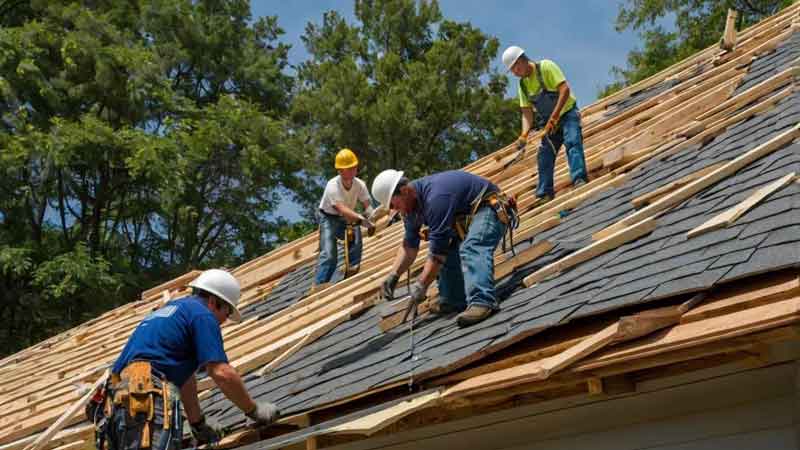
Roofing Services — Efficiency From the Top Down
Your roof is the single largest surface exposed to the sun, and an aging or dark roof can push attic temperatures well above 150°F, forcing your AC to work overtime. We install cool-roof and reflective shingle systems engineered to reduce solar heat gain, along with proper attic ventilation to keep heat from building up in the first place. A well-installed, energy-efficient roof protects your home from the elements while cutting cooling costs and extending the life of everything underneath it.
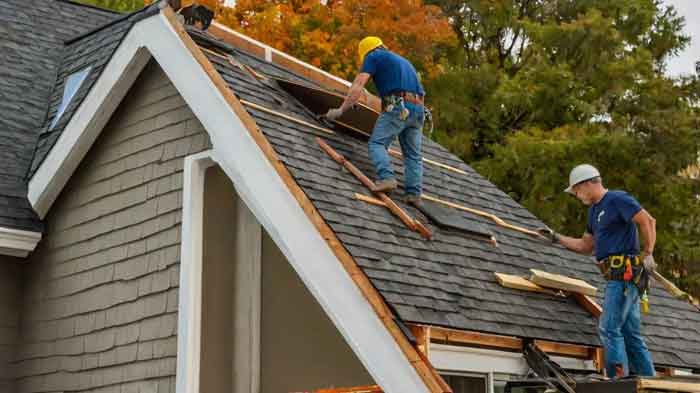
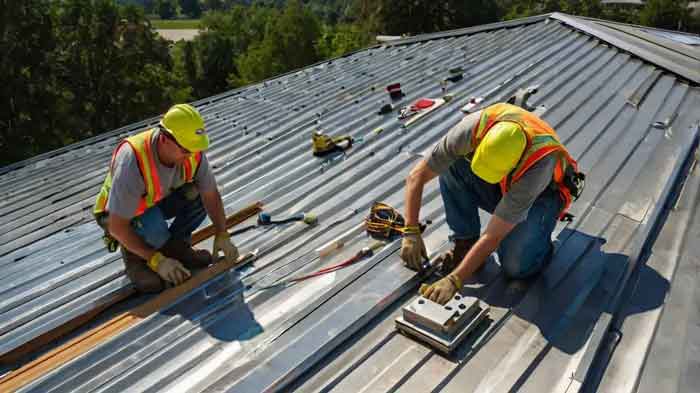
What's Included
ENERGY STAR-rated reflective/cool-roof shingle or tile options · Manufacturer-specified underlayment and ice-and-water-shield barriers · Balanced attic intake/exhaust ventilation to reduce heat buildup · Code-compliant flashing at valleys, vents, and penetrations · Full tear-off and haul-away of old roofing material · Post-install inspection for leaks and proper drainage · Free in-home roof and attic energy assessment
Get a Free Roofing Energy-Savings Estimate
Our Services
Head Office
LA Riverside and Orange County
Phone
(877) 303-1544
How We Work
Free In-Home Assessment & Energy Audit
We inspect your roof and attic for heat gain, ventilation gaps, and wear, and evaluate whether a reflective or cool-roof system would meaningfully lower your cooling costs.
Custom Efficiency-Focused Proposal
You receive a detailed proposal recommending reflective shingle or tile options and ventilation upgrades suited to your roof's pitch, orientation, and sun exposure.
Licensed, Professional Installation
Our crew tears off old roofing and installs your new system with manufacturer-specified underlayment, flashing, and fastening for a fully weathertight, code-compliant roof.
Quality Inspection & Walkthrough
We inspect every valley, vent, and penetration for proper sealing and drainage, clean the site, and walk the finished roof with you before calling the job complete.
Warranty & Ongoing Support
Your new roof is backed by manufacturer and workmanship warranties, and we remain available for any follow-up questions or maintenance needs.
California Codes & Your Rights: Roofing Done Right
1. Understanding Roofing Under California's Title 24 Energy Code
When California updated its energy code — Title 24 — to include mandatory cool-roof standards, the goal was simple: keep more of the sun's heat outside your attic instead of inside your living room. For homeowners across Orange County, Riverside, and the Inland Empire, where summer roof-deck temperatures can turn an attic into an oven, this single code requirement has an outsized effect on comfort and on the size of your monthly cooling bill.
Here's the physics in plain terms. A conventional dark asphalt roof absorbs the vast majority of the solar energy that hits it, and much of that heat radiates downward into the attic, warming insulation, ductwork, and ultimately the rooms below. Air conditioning systems then work harder and longer to compensate, which shows up as higher summer electric bills and more wear on HVAC equipment over time. A cool roof is engineered to reflect more of that solar energy back into the sky and to release the heat it does absorb more readily, rather than trapping it against the roof deck.
Title 24 measures a roofing product's performance using two core metrics: solar reflectance (how much sunlight the surface bounces away, on a 0-to-1 scale) and thermal emittance (how efficiently the surface releases absorbed heat, also on a 0-to-1 scale). These two figures are sometimes combined into a single Solar Reflectance Index, or SRI. For most low-slope residential roofs in California's more thermally demanding climate zones — broadly, the zones covering the bulk of the Inland Empire, Riverside County, and inland Orange County — the prescriptive path generally calls for an aged solar reflectance in the neighborhood of 0.63 and a thermal emittance around 0.75, which typically corresponds to an SRI in the area of 75. Steep-slope residential roofs — the pitched, shingle-and-tile style found on most single-family homes — are held to a different, lower prescriptive bar in the specified zones: an aged solar reflectance around 0.20 with thermal emittance around 0.75, or roughly an SRI near 16.
It's important to understand these are representative, typical figures rather than a single number stamped on every roof in the state. The exact prescriptive requirement that applies to your project depends on your specific climate zone, your roof's slope, and which Title 24 compliance path your contractor's documentation uses — there is also a "performance" compliance route that can trade off roof reflectance against other envelope and HVAC improvements. That's why a qualified, code-fluent roofing contractor pulls the current Title 24 requirement for your specific address and roof type rather than relying on generic assumptions, and documents the compliance path used at the time permits are pulled.
For homeowners, the practical takeaway is this: cool-roof compliance isn't red tape for its own sake — it's one of the more effective, lowest-maintenance upgrades available for reducing attic heat gain, easing the load on your air conditioning system, and making upstairs bedrooms noticeably more comfortable during the hottest months. When you re-roof, you're not just replacing worn material — you have an opportunity to bring an older roof up to a current, energy-smart standard, often with premium materials that look better and last longer than what they replace. Genesis Home Renovations reviews the applicable Title 24 reflectance and emittance requirements for your climate zone and roof pitch as a standard part of every roofing estimate, so the product recommendation you receive is matched to code from day one — not adjusted after the fact at inspection.
2. Licensing, Permits & Inspections for Roofing Work
Roofing is a licensed trade in California, and the specific license classification matters more than most homeowners realize. The California Contractors State License Board (CSLB) issues a dedicated C-39 Roofing Contractor classification to companies that install new roof coverings and repair the surfaces that seal, waterproof, and weatherproof a structure — this spans asphalt shingles, concrete and clay tile, slate, metal roofing, and membrane and other waterproofing systems. It's worth knowing what a C-39 license does not cover, too:
- Structural framing repair falls under a different classification — a C-5 or general B license — not C-39.
- Fabricating custom sheet-metal flashing is its own specialty, licensed as C-43.
A contractor who understands these boundaries will bring in the right licensed trade for any work that falls outside straight roofing scope, rather than stretching a single license to cover everything on a project.
Permits are the other half of doing roofing work correctly. Re-roofing a home in California generally requires a building permit from the city or county where the property sits — this isn't optional paperwork, it's the mechanism that gets a qualified inspector to verify the work meets current code, including the Title 24 cool-roof requirements discussed above and the fire-hazard provisions covered in the next section. Exactly how many inspections a given re-roof requires, and at which stages, varies by city and county, so it's worth confirming the specific process with your local building department or your contractor rather than assuming a one-size-fits-all number applies everywhere in the region.
Beyond the roofing-specific license, several broader CSLB requirements apply to any contractor working on your home, and they exist to protect you financially if something goes wrong. Every active CSLB license must be backed by a $25,000 contractor's license bond — that bond amount was raised from its previous $15,000 level effective January 1, 2023, under Senate Bill 607, specifically to give consumers a larger financial backstop. Workers' compensation insurance is likewise required for any licensed contractor who has employees, and roofing is one of five trade classifications where — because of the elevated physical risk involved — workers' comp coverage is mandatory regardless of employee count. A separate, broader law, Senate Bill 216, will eventually require workers' compensation coverage for all licensed contractors regardless of whether they have employees, but that expansion has been pushed back by Senate Bill 1455 to January 1, 2028 — it is not yet in effect statewide, so it's worth asking directly whether a given contractor already carries coverage voluntarily.
Taken together, the license classification, the bond, and workers' compensation coverage form a layered system: the license confirms competency in the specific trade, the bond provides a financial remedy if the contractor fails to perform or pay as agreed, and workers' comp protects both the workers on your roof and you, the homeowner, from liability if someone is injured on your property. Before signing anything, ask to see the contractor's license number and confirm it's active and in good standing — CSLB's public license lookup makes this a five-minute check that's well worth doing before a crew is ever on your roof.
3. Fire-Hazard Zones & Roofing Requirements in the Inland Empire
If your home sits within a state-mapped Fire Hazard Severity Zone or a designated Wildland-Urban Interface Fire Area — and substantial portions of Riverside County and the broader Inland Empire fall into these mapped areas — your roof isn't just a weatherproofing system, it's a frontline defense against ember intrusion during a wildfire. California addresses this directly by requiring a Class A roof covering for homes in these zones: a covering rated, through recognized testing methods such as ASTM E108 or UL 790, to withstand severe fire exposure from wind-driven embers and burning brands, rather than igniting or contributing to fire spread.
Where these requirements live in the code has actually changed recently, and it's worth knowing the current name if you're doing any research yourself. For years, these wildfire-related building requirements were folded into Chapter 7A of the California Building Code. As of January 1, 2026, that material was pulled out of Chapter 7A entirely and reorganized into its own standalone code: the California Wildland-Urban Interface Code, published as Part 7 of Title 24. If you see a contractor, inspector, or older document still referencing "Chapter 7A," know that the substance carries forward — it's simply been relocated and renumbered under its new, dedicated code. Genesis Home Renovations references the current Wildland-Urban Interface Code by name in any project scoped for a fire-zone property, so your permit documentation matches what your local building department is actually enforcing today.
Beyond the Class A covering requirement itself, California's building code sets firm limits on how roofing material can be layered during a re-roof — limits that matter whether or not your home sits in a mapped fire zone:
- A roof may carry a maximum of two layers of roofing material before code requires a full tear-off down to the deck; a third layer is never permitted regardless of material.
- For tile, metal, slate, and other non-shingle materials, only a single layer is ever allowed — re-roofing over an existing tile or metal roof with a second layer is not a compliant option.
- Tear-off to the bare deck is mandatory, independent of layer count, whenever the existing roof is water-soaked or otherwise structurally deteriorated.
- Tear-off is also mandatory where the existing material is slate, clay tile, cement tile, or asbestos-cement tile.
These layering and tear-off rules exist for good reason: additional layers add weight the original framing wasn't necessarily designed to carry, trap moisture between layers, and — critically for fire-zone homes — can undermine the fire performance of the assembly as a whole, since a Class A rating is typically tested and certified for a specific, complete roof assembly rather than an arbitrary stack of old and new material. For a homeowner in a mapped fire-hazard area, this means a re-roof is as much a safety decision as an aesthetic or maintenance one. Before recommending a product or a layering approach, a compliance-minded contractor should confirm whether your property falls within a mapped Fire Hazard Severity Zone or Wildland-Urban Interface Fire Area, and scope the project — material selection, tear-off requirements, and permit documentation — accordingly, rather than treating every re-roof in the region the same way.
4. Your Rights as a California Homeowner
California gives homeowners a specific, detailed set of legal protections when they hire a contractor for home improvement work, and understanding them helps you recognize a properly run project — and know what to expect on paper before any work begins.
Under Business & Professions Code Section 7159, any home improvement contract where labor and materials together exceed $500 must be in writing and signed by both parties, and that written contract has to include specific elements:
- The contractor's name, business address, and license number.
- A heading that identifies it as a "Home Improvement" contract.
- Approximate start and completion dates.
- A clear description of the work to be performed and the materials to be used.
- A payment schedule.
- A mechanics lien warning explaining lien rights connected to the project.
- A CSLB consumer-information notice.
- Disclosure of the contractor's insurance coverage.
- Where applicable, a notice of the three-business-day right to cancel.
A contract missing these elements isn't just sloppy paperwork — it's a sign the contractor may not be following the law that's designed to protect you.
That three-business-day cancellation right is worth understanding precisely, because it's commonly misunderstood as a blanket right that applies to every contract. Under Civil Code Section 1689.5 and related sections, the right to cancel within three business days applies specifically to "home solicitation contracts" — agreements signed somewhere other than the contractor's regular place of business, such as a sales presentation conducted in your home. It generally does not automatically apply when you, the homeowner, initiate contact with the contractor and the contract itself is signed at the contractor's own office. The cancellation window is also extended in certain circumstances — five business days for senior citizens, and seven days for contracts connected to a declared disaster — reflecting the added protection the law affords in those situations.
California law also limits how much a contractor can collect upfront. Under Business & Professions Code Section 7159.5, a down payment cannot exceed the lesser of $1,000 or 10% of the total contract price — meaning on a large re-roofing project, the legal cap is very likely $1,000 flat, not a percentage that scales with project size. Any request for a larger upfront payment should be a red flag.
You may also, at some point during a project, receive a document called a mechanics lien preliminary notice from a subcontractor or material supplier you may not personally recognize. Under Civil Code Section 8200 and related sections, subcontractors and material suppliers — parties who don't have a direct contract with you as the homeowner — are required to serve this notice within 20 days of first furnishing labor or materials on your project, specifically to preserve their own right to file a lien if they aren't paid. Receiving one is not a sign that anything is wrong with your project or your general contractor; it's a routine, legally required step built into how California protects the payment rights of everyone working on a job, from the general contractor down to the supplier who delivered your shingles.
Finally, you have direct tools to verify who you're working with. Any contractor's license can be checked, and any complaint filed, through the California Contractors State License Board — at cslb.ca.gov or by phone at 1-800-321-2752. CSLB generally has jurisdiction to act on complaints involving patent, or readily visible, defects for four years after the work is completed, and on latent, or hidden and structural, defects for ten years, under Business & Professions Code Section 7091 — giving you a meaningful window to raise concerns even after a project wraps.
5. How Genesis Home Renovations Keeps Your Project Fully Compliant
Compliance isn't a box we check after the fact — it's built into how we scope, permit, and execute every roofing project from the first estimate through final sign-off. Before a single shingle or tile is ordered, our process starts with confirming what actually applies to your property: your climate zone's Title 24 cool-roof requirements, whether your address falls inside a mapped Fire Hazard Severity Zone or Wildland-Urban Interface Fire Area, and the layering and tear-off condition of your existing roof. That groundwork determines the material recommendation you receive, so the product we propose is one we already know will pass inspection — not one we hope will.
On the paperwork side, every project is backed by a written contract built around the disclosures California law requires: our name, address, and license information; a clear description of the work and materials; a realistic payment schedule that respects the legal down-payment cap; the required mechanics lien and consumer-information notices; and disclosure of our insurance coverage. You'll always know what you're signing and why each piece of it is there — nothing buried, nothing rushed.
Before work begins, we pull the required building permit through your local jurisdiction, so an independent inspector — not just our own crew — verifies the finished roof meets current code, including cool-roof reflectance and emittance standards and, where applicable, Class A fire-rated assembly requirements. We coordinate the inspection schedule directly with your local building department so the project moves forward without needless delay, and we keep you informed of where things stand at each stage rather than leaving you to guess. When the work is complete, you receive the documentation that matters:
- Your signed permit and inspection records.
- The specifications for the materials actually installed.
- A plain accounting of how the finished roof meets the code requirements that applied to your address.
This approach is exactly why we operate as Licensed, Bonded & Insured — carrying the CSLB license and bond coverage current California law requires, along with the workers' compensation protection that safeguards both our crews and your property. It's also why we offer a Free Estimate on every roofing project: getting a clear, code-grounded picture of your roof's condition and requirements shouldn't cost you anything upfront. And it's why we hold ourselves to being On-Time, On-Budget, backed by a 5.0 Rated track record with homeowners across Orange County, Riverside, and the Inland Empire. Compliance and quality aren't separate conversations for us — a roof that's installed correctly, permitted correctly, and documented correctly is simply what a well-run project looks like from the first estimate to the final inspection sign-off.
6. Frequently Asked Questions — California Roofing Regulations
Do I need a permit to replace my roof in California?
In almost all cases, yes. Re-roofing generally requires a building permit from your city or county, which is what allows an inspector to confirm the finished roof meets current requirements — including Title 24's cool-roof standards and, if your property is in a mapped fire-hazard area, Class A fire-rated covering requirements. The exact number of inspections and the specific process varies by jurisdiction, so it's worth confirming the details with your local building department or your contractor before work begins.
What does a "Class A roof" mean, and does my home need one?
A Class A roof covering is rated, through recognized tests such as ASTM E108 or UL 790, to resist ignition and fire spread from wind-driven embers — the kind of exposure a home faces during a wildfire. It's required for homes within a state-mapped Fire Hazard Severity Zone or a designated Wildland-Urban Interface Fire Area, categories that cover substantial parts of Riverside County and the Inland Empire. As of January 1, 2026, these requirements are set out in the new California Wildland-Urban Interface Code (Title 24, Part 7), which replaced the older Chapter 7A framework. If you're not sure whether your address falls in a mapped zone, your contractor or local building department can confirm it.
How much of a down payment can a roofing contractor legally ask for?
Under California law, a contractor's down payment cannot exceed the lesser of $1,000 or 10% of your total contract price. On most roofing projects, that legal cap works out to $1,000 flat rather than a percentage of the job. If a contractor asks you for more than that upfront, that's worth questioning before you sign anything.
Do I automatically get three days to cancel my roofing contract?
Not always — it depends on where the contract was signed. The three-business-day cancellation right under California's home solicitation contract law applies when the agreement is signed somewhere other than the contractor's regular place of business, such as during a sales visit at your home. It generally doesn't apply automatically when you reach out to the contractor yourself and sign the agreement at their office. The window extends to five business days for senior citizens and seven days for contracts tied to a declared disaster.
I received a "preliminary notice" from a supplier I've never worked with directly — should I be worried?
No — this is a routine and legally required step, not a warning sign. California law requires subcontractors and material suppliers who don't have a direct contract with you to send a preliminary notice within 20 days of starting work or delivering materials, specifically to preserve their own right to file a mechanics lien if they aren't paid by the party that hired them. Receiving one simply means the law's payment-protection system is working as designed.
How can I check whether a roofing contractor's license is valid?
You can look up any contractor's license status directly through the California Contractors State License Board at cslb.ca.gov, or by calling 1-800-321-2752. The same channel lets you file a complaint if you ever need to — CSLB generally has jurisdiction over complaints involving visible defects for four years after work is completed, and hidden or structural defects for ten years.
The information above is provided as general educational content about California's building and energy code framework and consumer-protection laws as they relate to roofing — it is not legal advice, and it isn't a substitute for reviewing your specific project with a qualified professional. Codes, fire-hazard zone maps, permit processes, and inspection requirements vary by city and county and are updated over time, so the figures and requirements described here should always be confirmed against current local ordinances before you rely on them for a specific project. For definitive answers about your property, contact your local building department, the California Contractors State License Board (cslb.ca.gov), or a licensed attorney as applicable.
Genesis Home Renovations is glad to walk you through exactly how these requirements apply to your specific address and roof as part of a free, no-obligation estimate. Call us at (877) 303-1544 to schedule yours and get a clear, code-compliant plan for your roof.
We're Here for You 24/7
Commitment to Quality and Exceptional Customer Support
Testimonials

See What Our Clients Are Saying. Genuine Feedback, Genuine Results